
Content strategy
Case Study 2How I guided a low‑code product into cross-functional territory by introducing a technical term and process with lightweight explanatory patterns.
Dynamics 365 Virtual Agent had decoupled from Customer Service Insights and found a new home in Power Platform. The new Power Virtual Agents was evolving from a low-code/no-code tool for SMEs into a product used by cross-functional teams, including technical contributors. With that came increased functionality and the need for more terms to describe it.
A new feature allowed makers to define structured, domain-specific information that the bot could extract from natural language. The most accurate label for this concept was a technical term already established in Azure and the broader data-science community: entity.
The ProblemWithout a background in database managment or data science, the term “entity” could mean.. anything
The concept needed a name, and would feature prominently in navigation and as a selling point
Industry and competitors were a consideration
Alternative labels (“slot filling,” “data type,” etc.) were not clear enough and too complex
Aligning to this term would later highlight a major term conflict within Microsoft
My Role
UX Content Designer specializing in terminology and conceptual clarity
Responsible for introducing the technical term in a way that:
preserved the low‑code experience
supported technical contributors
aligned with Azure and the industry, competitors
Designed the explanatory patterns that taught users how to configure the feature
Partnered with PM, design, data science, and research to validate comprehension
My Process
A. Positioned the technical term with a clear, approachable definition
Introduced the term with plain language
Anchored it in real‑world examples
Created a shared mental model for SMEs and technical users
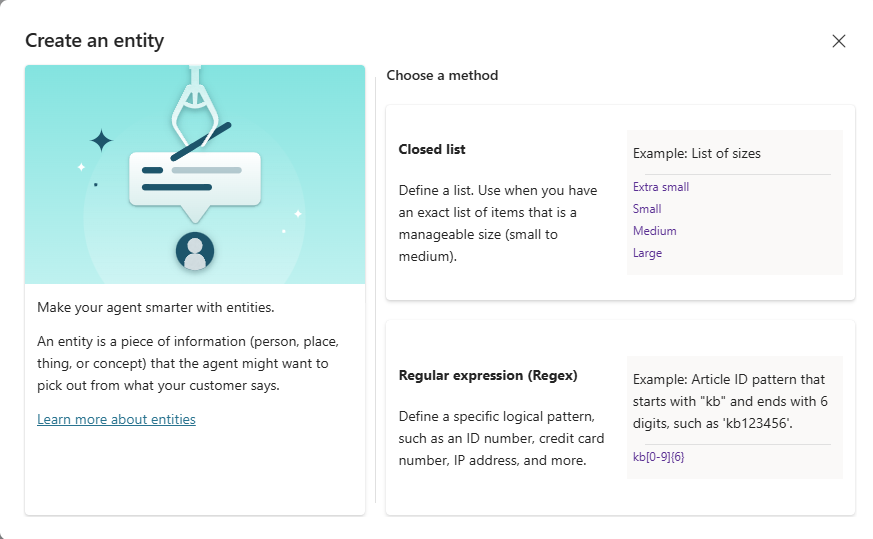
B. Designed lightweight explanatory patterns for configuration
Framed choices around user intent, not technical theory
“Use a list when…” → known values
“Use a pattern when…” → values follow a format
Paired technical labels (e.g., Regex) with plain‑language explanations
Used examples to make abstract concepts concrete
C. Hid complexity behind optional, supportive content
Helper text
Inline examples
Short, focused modals
Progressive disclosure so SMEs weren’t overwhelmed
D. Ensured alignment with Azure without importing unnecessary complexity
Preserved the canonical term
Avoided introducing competing labels
Clarified the boundaries between PVA’s implementation and Azure’s
E. Validated the pattern with cross‑functional teams
SMEs understood the concept without needing ML knowledge
Technical users recognized and trusted the term
The pattern scaled across features
The OutcomeSMEs could build their knowledge of data science
Technical contributors recognized and trusted the terminology
The feature shipped with strong comprehension and low support burden
The explanatory pattern became a model for introducing other technical concepts
The product evolved without losing the clarity that defined it